
Moving towards a climate-neutral and digitalised world calls for new skills, both at work and in our everyday lives. The EU Commission wants to help people acquire these skills, and the BeWell project aims to illuminate the priorities for those working in the health sector.
We live in a time of change and are faced with two central challenges, both in Europe and globally. One of these involves making the economy and society climate neutral as quickly as possible. The other is to use digitalisation for the maximum benefit of people and nations. Meeting these challenges calls for new skills and expertise – both in the health sector and in all other areas of the working world and society.
Sustaining high quality care: interprofessional training for our clinical and public health workforce
14 November 2022
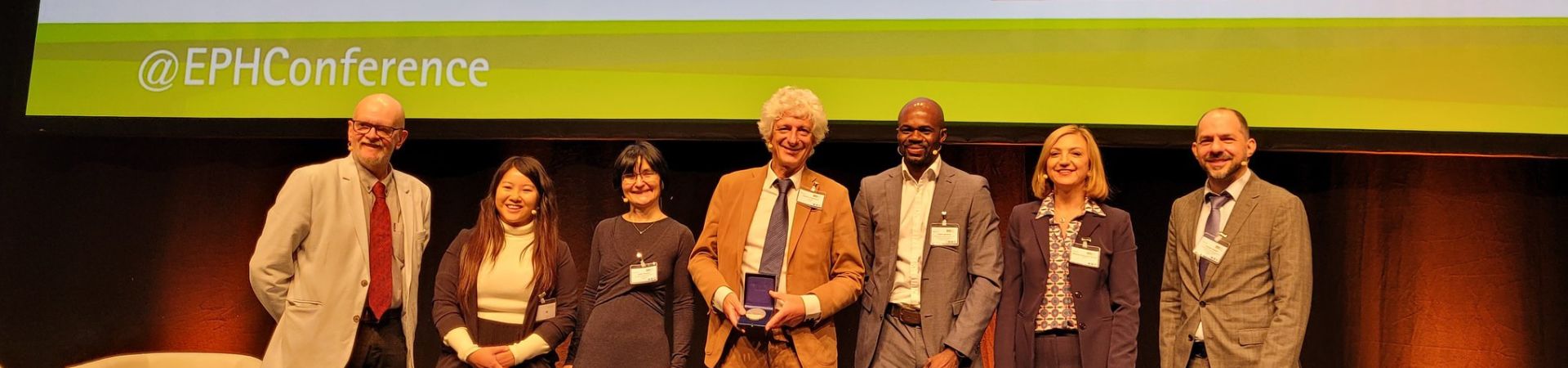
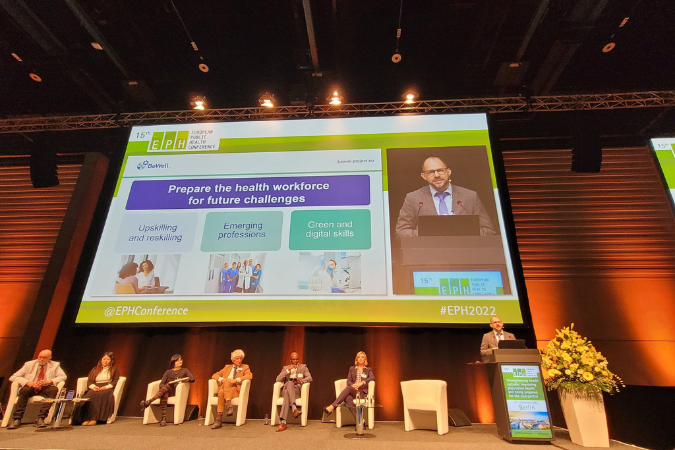
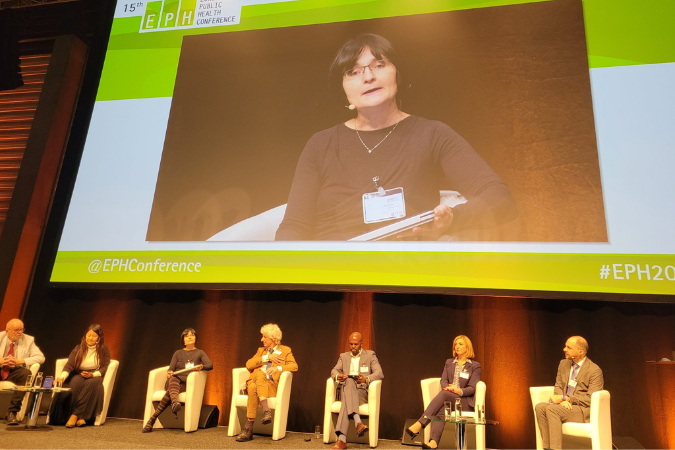
EHMA and ASPHER jointly organised the high-level plenary session ‘Sustaining high quality care: interprofessional training for our clinical and public health workforce’ during the European Public Health – EPH Conference 2022. This plenary was the occasion for EHMA to present our landmark project, BeWell, of which we are consortium leader, and its skills strategy for the European health workforce in front of an expert audience of public health professionals and health leaders. Our Executive Director, George Valiotis and our Director of Policy and Programmes, Anett Ruszanov were joined by Dr Natasha Azzopardi Muscat (WHO Regional Office for Europe); Dr Fatai Ogunlayi (Health Security Agency); and Prof Laurent Chambaud (EHESP School of Public Health) to discuss how to prepare the health workforce for future challenges.
On 10-12 November 2022, EHMA attended the European Public Health – EPH Conference in Berlin, Germany on the theme ‘Strengthening health systems: improving population health and being prepared for the unexpected’. The EPH Conference was a great occasion to represent the health management perspective and develop synergies with the public health sector; meet several of our members equally present at the event; and disseminate some of our projects addressing core conference topics.
The EPH Conference prominently featured the topic of health workforce. Digital health literacy and the mental and physical wellbeing of health professionals were focus areas highlighted through different projects, practices and policy initiatives. As consortium leader of the BeWell – Blueprint alliance for a future health workforce strategy on digital and green skills project, EHMA was pleased to co-organise with ASPHER and present at the plenary session ‘Sustaining high quality care: interprofessional training for our clinical and public health workforce’. Moderated by John Middleton, President of ASPHER, and Tara Chen, Climate-Health Fellow at ASPHER, the plenary featured two keynotes by Dr Natasha Azzopardi Muscat, Director of the Division of Country Health Policies and Systems at WHO Reginal Office for Europe and George Valiotis, our Executive Director, as well as a panel discussion with Dr Fatai Ogunlayi, Public Health Specialty Registrar UK, Health Security Agency; Prof Laurent Chambaud, EHESP School of Public Health; and Anett Ruszanov, our Director of Policy and Programmes.
In these times of permacrisis job positions requiring long hours of stressful work, not receiving moral and financial recognition commensurate with the level of education, do not make the sector attractive for young professionals. In addition, the workforce deciding to leave their jobs risk to compromise the quality of healthcare delivery. Workforce shortages characterise the whole sector, although some professions are more impacted than others. By 2050, the EU will have to cope with a shortage of 50 million health professionals in total.
Europe should be able to supply a sufficient number of health professionals, but healthcare jobs need to be rewarded, attractive and appropriately remunerated. The BeWell project can help to restate this attractiveness. The upskilling and reskilling strategy can be a vehicle towards presenting the health sector as agile, resilient, and able to adapt to new emerging challenges such as the digital transformation and climate change. The objective of the strategy is to offer training opportunities so that professionals have access to relevant knowledge sources and reduce their workload and stress level while maintaining high quality, efficient, effective, accessible and person-centred care delivery.
The BeWell project is co-funded by the Erasmus+ programme of the European Union under Grant Agreement number 101056563. This page only reflects the author’s views and do not necessarily reflect those of the European Union or EACEA. Neither the European Union nor the granting authority can be held responsible for them.
New skills for a green and digital future
Excerpt from the article ‘New skills for a green and digital future‘ by Dietmar Schobel appeared on in ‘Healthy Europe – November 2022 EPH Conference’. The full article is available here.
Recent News
New report published: Consolidating infant rsv prophylaxis – evidence and policy guidance for European health systems.
Addressing medication waste: an EU priority for sustainable health systems
CARE Summit: building a stronger European Health Union
What our Members say
I have been active in EHMA since the first years of the '90s and I have seen its evolution from a small association of members interested in sharing knowledge on health management practices to the current status of reference and advisory key player for EU, health systems and organisations, stakeholders associations, industry and universities. EHMA is now a unique knowledge hub, policy advisor, community of practice and network of best in class organisations involved in health policy and management. A place where health managers can build their competences, policy-makers and stakeholder associations envision how to implement and sustain change through health management, industry leaders understand how to engage more effectively with health organisations and systems. The right place to nurture and grow health management capabilities and capacity for every stakeholder of health systems.
Prof. Federico Lega, University of Milan, Italy
Health management has a crucial function in shaping public health and health system challenges. The Medical University of Varna, Bulgaria had success in collaborating with EHMA on EU-funded projects that has resourced us to create new health management competencies for the future workforce. In addition to all classical definitions, health management is a science dealing with individuals, groups, and society at large. It is an art contributing to the beauty of our lives and an interactive communication process at all levels of institutions and human energy. I have also had the pleasure to chair the South Eastern European Special Interest Group which gives members a space to discuss and tools to address how health systems are managed in our regions.
Prof. Todorka Kostadinova, Medical University of Varna, Bulgaria
I enjoy the high level of interaction and engagement in EHMA’s activities, in particular during the annual conference where the panel discussions are rich and well prepared. As a hospital manager and professor of health management, EHMA motivates and inspires me to be creative. You go back home feeling energised from seeing old friends and making new connections, as well as being convinced of serving as EHMA’s ambassador. It’s a strong feeling of interdisciplinary engagement, but it also feels like being part of family-like community.
Prof. Sandra C. Buttigieg, University of Malta, Malta
EHMA is a pre-eminent organisation for everyone working in planning, managing and delivering health services across Europe. As a long standing member of EHMA I have always been impressed by the vibrant community of managers, researchers and academics it has created and by the many opportunities for sharing knowledge and funding opportunities it has brought to its members. Its international scope is impressive and its impact is often felt in management and research across European and national health systems.
Prof. Axel Kaehne, Edge Hill University, UK
Health workforce has become more essential in operating, managing and maintaining health systems lately, particularly in crisis and emergency situations. European healthcare professions and the workforce need to be high on the agenda of managers and decision makers. The Health Services Management Training Centre, Semmelweis University in Hungary is a longstanding EHMA member, because it connects us with collaborators and experts, with whom we can have complex debates, from whom we can learn and at the end find solutions in various challenging fields of healthcare management.
Dr Eszter Kovács, Health Services Management Training Centre, Semmelweis University, Hungary
As a hospital administrator and health management professor, I see on a daily basis that the healthcare challenges require talented and skilled managers to transform it. the EHMA membership has been beneficial to bring healthcare management research and education to the demanding healthcare services world, promoting healthcare management competencies and knowledge creation.
Dr Alexandre Lourenco, APAH - Association of Portuguese Hospital Managers, Portugal
Many healthcare systems in Europe and beyond are facing similar challenges which require innovative and creative solutions. EHMA’s annual conference, webinars, Programme Directors’ group and other activities and resources provide incredible opportunities for networking, connecting and sharing experiences. A distinct feature of EHMA is the diversity of members with representation from many countries, sectors and different communities of practice – academic, policy-makers, practitioners, managers, leaders and students. The annual conference is a highlight in the calendar year, offering a friendly, fun and learningful environment for emerging and established members to engage, collaborate and meet up with old and new friends. I am proud to be a member of the EHMA Board.
Prof. Ann Mahon, University of Manchester, UK
Society evolution, pandemics and ageing modify health needs. So, health policies and services are to change dramatically. EHMA, through webinars, workshops and annual conference provides an excellent insight to a professional changing world, favouring closeness to management innovation and the protagonists of these changes. As a primary care services’ manager, participating in EHMA activities is really worth it and allows to involve oneself in the innovation processes.
Dr Antoni Peris Grao, Consorci Castelldefels Agents de Salut (CASAP), Spain