Strengthening Medicine Supply Resilience Through Digital Transformation
3 April 2025
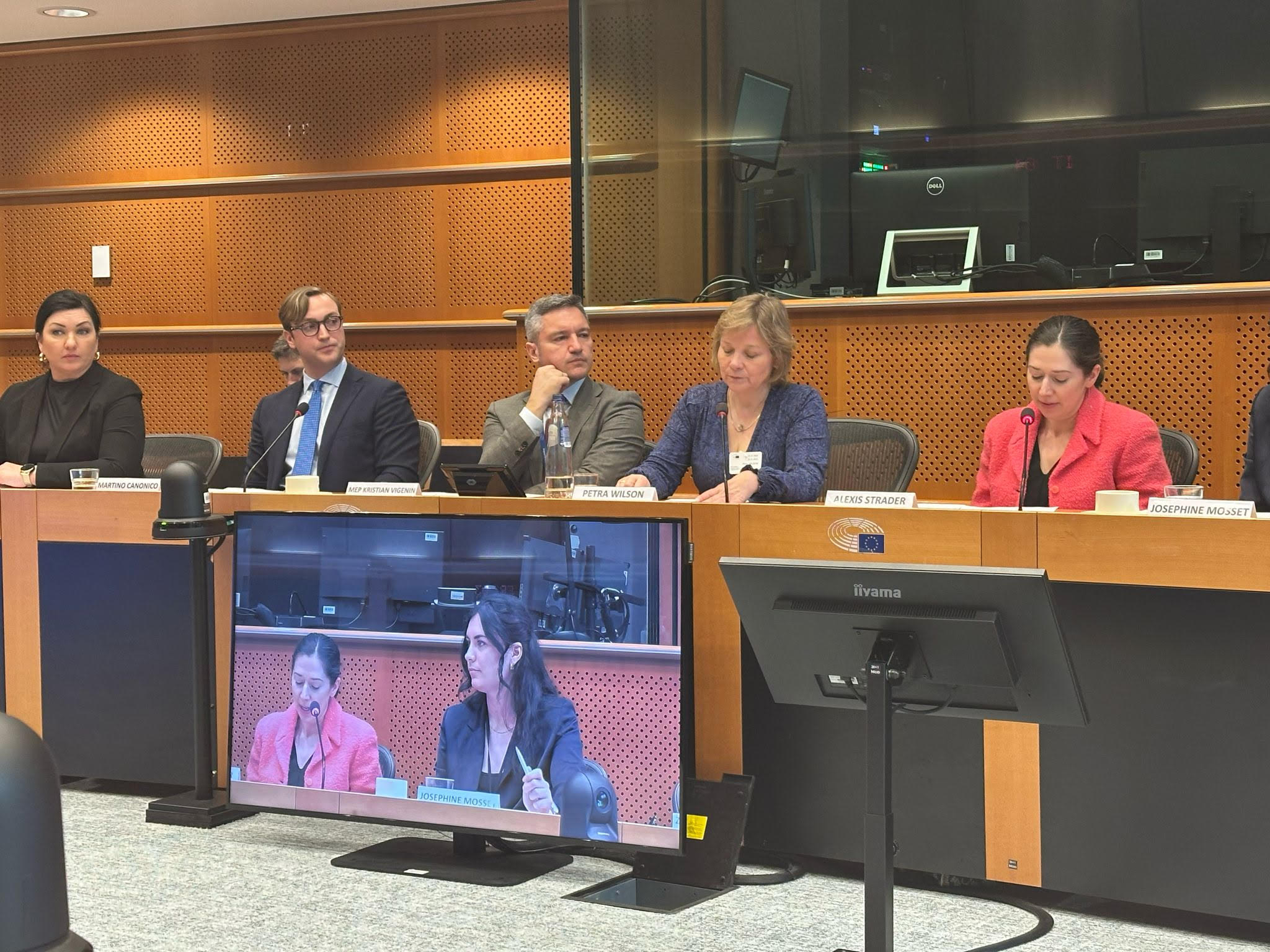
Earlier this month, the European Health Management Association (EHMA) represented both our organisation and the Online Order and Home Delivery of Medicines Alliance (OnHOME) at a key at the event ‘Equitable Access to Medicines Across Europe: The Role of Digital Solutions’ hosted by MEP Kristian Vigenin (S&D, Bulgaria) at the European Parliament.
At this event, Alexis Strader, EHMA’s Director of Policy and Research, joined a panel of experts to discuss the role of digital solutions in addressing medicine shortages and strengthening healthcare resilience. The panel, moderated by Petra Wilson, featured perspectives from Zlatimira Dobreva (Counsellor for Health, Permanent Representation of the Republic of Bulgaria to the EU), Martino Canonico (Head of Brussels Office, European Association of E-Pharmacies – EAEP), Baiba Ziemele (Chairwoman, Latvian Network of Patient Organizations – LPOT), and Josephine Mosset (Policy Officer, Cancer Patients Europe – CPE).
Alexis stated that medicine shortages are no longer isolated incidents; they have become a systemic challenge across Europe, threatening treatment continuity, patient safety, and the sustainability of health systems. Tackling this issue requires innovative solutions, enhanced collaboration, and digital transformation. Alexis discussed that the European Shortages Monitoring Platform (ESMP) plays an essential role in tracking critical medicines, more detailed, real-time data is needed. Additionally, she used the example of retail pharmacies because they are not always digitally connected to national or European monitoring systems, which limits the ability to fully assess medicine availability across all healthcare settings.
Challenges in Digital Transformation
EHMA recognises that despite the clear benefits of digitalisation, several barriers remain. Alexis identified three major challenges that need to be addressed:
- Investment and funding constraints – Many healthcare institutions, including hospitals and pharmacies, struggle to secure the financial resources needed to implement and maintain digital inventory management systems.
- Outdated infrastructure – A significant number of hospitals and pharmacies still rely on manual inventory systems, leading to inefficiencies and delays in responding to medicine shortages.
- Resistance to change – Successful digital transformation requires more than technology; it necessitates behavioural and cultural shifts. Many healthcare professionals need targeted training to effectively use digital tools.
EHMA believes that overcoming these barriers requires strong political will, strategic investments, and capacity-building efforts across the healthcare sector.
The Role of Hospitals in Strengthening Medicine Supply Resilience
Hospitals play a critical role in monitoring medicine supply, yet only 66% of hospitals in the EU have pharmacy information systems, and 75% still rely on manual inventory management. This lack of real-time stock monitoring leads to:
- Inefficiencies and delays in responding to shortages.
- Costly emergency procurement due to lack of foresight.
- Increased waste, as expired medicines are harder to track manually.
EHMA strongly support the integration of automated, real-time inventory management systems in hospitals, which would enhance visibility, improve stock allocation, and enable proactive responses to supply chain disruptions.
EHMA’s Policy Recommendations and Calls to Actions
To effectively address medicine shortages and improve digital readiness, EHMA calls on EU policymakers to:
- Embed digitalisation in upcoming legislation to improve medicine supply chain resilience.
- Ensure the Critical Medicines Act (CMA) prioritises automation in hospital stock management.
- Allocate EU funding (such as EU4Health and Digital Europe) to support the digitalisation of medication management pathways in hospitals.
- Develop national interoperable IT systems to enable real-time data exchange across the European Shortages Monitoring Platform (ESMP).
Expanding Digitalisation to Retail Pharmacies
Beyond hospitals, retail pharmacies must be better integrated into national and EU monitoring systems. While some hospital pharmacists are already connected to the ESMP, many retail pharmacists remain outside these digital networks. EHMA identifies several key challenges to integrating retail pharmacies into digital tracking systems, including:
- Funding limitations – Many small pharmacies lack the resources to invest in digital infrastructure.
- Gaps in IT systems – Many still rely on manual processes that limit their ability to share real-time data.
- Workforce adaptation challenges – Staff training and digital literacy initiatives are needed to encourage adoption of new technologies.
We believe that addressing these gaps will create a more comprehensive, resilient medicine supply system that serves the needs of both healthcare providers and patients.
The European Health Data Space (EHDS) – A Transformative Opportunity
Looking ahead, the European Health Data Space (EHDS) presents a significant opportunity for enhancing medicine management and healthcare delivery across Europe. EHMA supports the EHDS as a means to:
- Enable cross-border access to medication, ensuring continuity of care for patients.
- Improve patient safety by reducing medication errors through access to a comprehensive medication history.
- Provide real-time stock visibility, allowing policymakers, industry, and healthcare professionals to proactively manage medicine shortages.
For health managers, policymakers, industry, and researchers, the EHDS offers a powerful tool for data-driven decision-making, supply chain resilience, and innovation in healthcare. EHMA will continue to advocate for its effective implementation to ensure equitable access to medicines across Europe.
EHMA’s Commitment to Strengthening Healthcare Resilience
As Alexis highlighted during the event, closer collaboration between policymakers, healthcare providers, industry stakeholders, and hospitals is essential to driving sustainable, patient-centred healthcare solutions.
EHMA will continue to engage with policymakers and stakeholders to advance digital transformation in medicine management, ensuring affordable, accessible, and sustainable healthcare for all.
Recent News

New report published: Consolidating infant rsv prophylaxis – evidence and policy guidance for European health systems.
Addressing medication waste: an EU priority for sustainable health systems
CARE Summit: building a stronger European Health Union
What our Members say
I have been active in EHMA since the first years of the '90s and I have seen its evolution from a small association of members interested in sharing knowledge on health management practices to the current status of reference and advisory key player for EU, health systems and organisations, stakeholders associations, industry and universities. EHMA is now a unique knowledge hub, policy advisor, community of practice and network of best in class organisations involved in health policy and management. A place where health managers can build their competences, policy-makers and stakeholder associations envision how to implement and sustain change through health management, industry leaders understand how to engage more effectively with health organisations and systems. The right place to nurture and grow health management capabilities and capacity for every stakeholder of health systems.
Prof. Federico Lega, University of Milan, Italy
Health management has a crucial function in shaping public health and health system challenges. The Medical University of Varna, Bulgaria had success in collaborating with EHMA on EU-funded projects that has resourced us to create new health management competencies for the future workforce. In addition to all classical definitions, health management is a science dealing with individuals, groups, and society at large. It is an art contributing to the beauty of our lives and an interactive communication process at all levels of institutions and human energy. I have also had the pleasure to chair the South Eastern European Special Interest Group which gives members a space to discuss and tools to address how health systems are managed in our regions.
Prof. Todorka Kostadinova, Medical University of Varna, Bulgaria
I enjoy the high level of interaction and engagement in EHMA’s activities, in particular during the annual conference where the panel discussions are rich and well prepared. As a hospital manager and professor of health management, EHMA motivates and inspires me to be creative. You go back home feeling energised from seeing old friends and making new connections, as well as being convinced of serving as EHMA’s ambassador. It’s a strong feeling of interdisciplinary engagement, but it also feels like being part of family-like community.
Prof. Sandra C. Buttigieg, University of Malta, Malta
EHMA is a pre-eminent organisation for everyone working in planning, managing and delivering health services across Europe. As a long standing member of EHMA I have always been impressed by the vibrant community of managers, researchers and academics it has created and by the many opportunities for sharing knowledge and funding opportunities it has brought to its members. Its international scope is impressive and its impact is often felt in management and research across European and national health systems.
Prof. Axel Kaehne, Edge Hill University, UK
Health workforce has become more essential in operating, managing and maintaining health systems lately, particularly in crisis and emergency situations. European healthcare professions and the workforce need to be high on the agenda of managers and decision makers. The Health Services Management Training Centre, Semmelweis University in Hungary is a longstanding EHMA member, because it connects us with collaborators and experts, with whom we can have complex debates, from whom we can learn and at the end find solutions in various challenging fields of healthcare management.
Dr Eszter Kovács, Health Services Management Training Centre, Semmelweis University, Hungary
As a hospital administrator and health management professor, I see on a daily basis that the healthcare challenges require talented and skilled managers to transform it. the EHMA membership has been beneficial to bring healthcare management research and education to the demanding healthcare services world, promoting healthcare management competencies and knowledge creation.
Dr Alexandre Lourenco, APAH - Association of Portuguese Hospital Managers, Portugal
Many healthcare systems in Europe and beyond are facing similar challenges which require innovative and creative solutions. EHMA’s annual conference, webinars, Programme Directors’ group and other activities and resources provide incredible opportunities for networking, connecting and sharing experiences. A distinct feature of EHMA is the diversity of members with representation from many countries, sectors and different communities of practice – academic, policy-makers, practitioners, managers, leaders and students. The annual conference is a highlight in the calendar year, offering a friendly, fun and learningful environment for emerging and established members to engage, collaborate and meet up with old and new friends. I am proud to be a member of the EHMA Board.
Prof. Ann Mahon, University of Manchester, UK
Society evolution, pandemics and ageing modify health needs. So, health policies and services are to change dramatically. EHMA, through webinars, workshops and annual conference provides an excellent insight to a professional changing world, favouring closeness to management innovation and the protagonists of these changes. As a primary care services’ manager, participating in EHMA activities is really worth it and allows to involve oneself in the innovation processes.
Dr Antoni Peris Grao, Consorci Castelldefels Agents de Salut (CASAP), Spain